Did you ever step over a rug, or slip on the wet tile and ask yourself, Who made this? The design of homes over the last few years has been following fashion more than science- placing more emphasis on open spaces and appearing finishes to the exclusion of basic safety. But the world’s changed. The increasing number of climate risks, an ageing population, and the interest in wellness mean homeowners redefine the qualities required of an actual home. Safety isn’t extra anymore. It’s essential.
In this blog, we shall tell you how contemporary houses are being constructed and renovated, safety being the basis, and not the re-thoughts. We are going to find out what is driving the change, what characteristics make a real difference, and what sort of spaces the families are creating that are smarter, more secure, and still good-looking.
Designing without stalling to a disaster
Smart design isn’t reactive. It plans ahead. That is the ability to consider worst-case scenarios in advance. Fire-resistant materials are becoming the order of the day in such places as California. The use of tempered glass windows and metal roofs by the builders is not only appealing to the eye, but also due to fire protection during wildfires. The houses in flood-prone areas are being raised or going up with flood vents. It’s not paranoia. It’s preparation.
The safety-first psyche is transforming each room in the house. Kitchens have induction cooktops which do not retain heat. Stairs are broader, more illuminated and there are grab rails usually placed on either side. These decisions do not shout of medical but they make the risk of injury less. This is where architecture connects with decency.
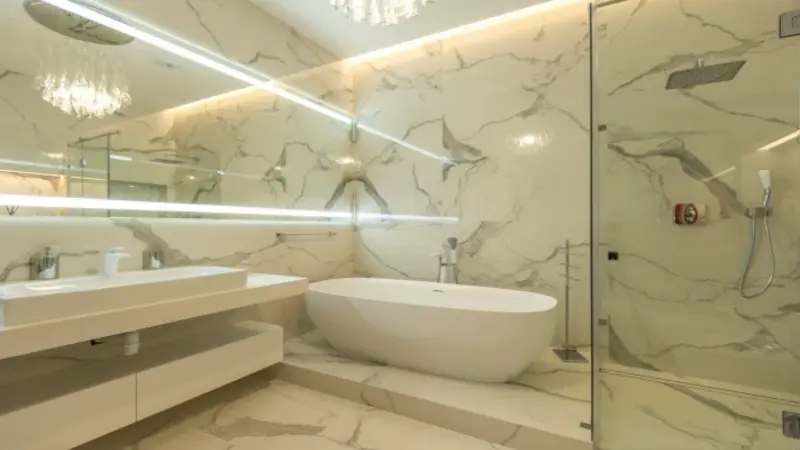
However, bathrooms are taking the centre stage in safety redesign. This is because they are the worst room in the house. And not just for older adults. Unsteady floors and clumsy floor plans can cause any person (toddler, teenager, etc.) to fall. Homeowners who would wait to need available features are now demanding them when undergoing a routine remodel.
Bath installation projects are becoming safety-oriented. Walk-in bowls, shower heads with no threshold, and lever tap are not unique to the retirement communities anymore. They belong to a general design approach that will make a home easier to reside in regardless of your age and ability. It is not about compromising on the style either. The presence of modern fixtures starts a fusion of the functionality and beauty so much that you might not see the practical benefits at a glance.
Such simple things as an installation of a towel bar that would be within the reach of the shower can help a lot. Or replacing ceramic tiles with slip-resistant vinyl that still is classy. Multi Curtail (small decisions). These are not backups in case of an emergency. They are inculcated into the original plan.
Security Meets ordinary convenience
It is ironic how the most technologically advanced homes are the ones that are secure. No, I say yes, that voice-activated assistant which turns on the lights can prevent a fall as well. Smart lighting systems which brighten up gradually in the morning or respond to motion during the night reduce accidents. They’re convenient, sure. Still, they are also pro-safety without making it public.
The kitchen has touchless faucets that aid in the reduced spread of germs. The Keyless entry implies that you never need to misplace a key, whether you are bringing groceries. It can have a smart thermostat which can heat a bath and warm up a cold floor before you walk around with bare feet. These attributes are not marketed as safety devices but they help to make the home a safer place.
The sweet spot is the design that will work twice. Still, it is not just about gadgets. Safety is affected by the placement of furniture, storage options and even color contrasting between the floor and the Wall. Open access helps to move around the house in a more convenient and safe way. Close drawers will not have any pinched fingers and bruised shins. Light switches which can be accessed at the bed are useful in crises at nighthours.
What’s Driving the Shift
Aging-in-place trends are one of the leading impetuses. The use of homes is experiencing changes whereby people desire to remain longer in the homes despite changing physical needs. Many are redesigning at a younger age, instead of waiting till they are restricted in mobility. They introduce ramps, open door frames and rebrandish bathrooms in such a way that in case something does occur, say a surgery, or a temporary injury, then they are already in line to succeed.
Though there is a cultural change as well. Homeowners are considering livability after decades of glitzy remodeling that focused on the resale price. Granite counter tops are becoming less important than health and safety. And since there is an increase in healthcare expenses, it is a good financial decision to avoid injuries at home.
Recent economic uncertainty has also increased awareness of people towards how their home can be adapted to suit their various purposes. Work, school, care giver, rest homes are doing all that is possible and they should do it safely. Parents desire the expansion in their rooms as the children do. Remote employees desire to have areas which will not cause backaches and poor lighting.
Next are the environmental dangers: hurricanes, blackouts, heatwaves and even pandemics. These facts have compelled homeowners to reconsider what their real meaning of peace of mind is. It is not only the matter of alarms or insurance. It is all about knowing that your area is prepared to deal with anything life presents to it.
How to Start Thinking This Way
When you are about to remodel, please, you only pose one question to your contractor: What can we do to make this space safer and more attractive without making it look clinical? You would wonder how much they can recommend. Install supplements on the walls in anticipation of grab bars. Install outlets on a higher part of the wall so that one does not have to bend down. Select the door handles which can be opened with your elbows in case you have something in your hands.
When purchasing or constructing a new house go beyond the granite and hardwood. Think about layout. Does it have a main floor bathroom? Do we have the hallways broad enough to get two people to walk abreast? Do stairwells have sufficient lighting?
Nothing can be boring and passed off as safe. On the contrary, the safety features are not concealed under wrapping papers on the best designs. Sleek grab bars can be used as a towel rack. The slope of the shower floor is light in order to match the remaining part of the bathroom. Practicality and beauty do not go hand in hand.
The Bigger Picture
Everything becomes easy when the homes are designed to be safe. People recover faster. Families stress less. Emergencies don’t spiral. And houses turn into real sanctuaries–places that will help us when we are in good health and will help us when we are not.
This is not only about safety among the elderly or those with disabilities. It is all about making houses more intelligent, considerate and more real. It is the fear of never having to look into the future. And it is already occurring in community neighborhoods all over the country.
Those designers and homeowners who do this correctly are not compromising on beauty or less innovation. They are creating space that is longer, harder and serves better. Houses which are responsive to the needs of people, not only to Pinterest pins or resale inspection lists.