Austin’s long warm seasons make outdoor living a genuine extension of the home. Outdoor kitchens, fire pits, and pergolas demand the same architectural discipline as any interior space: considered proportions, durable finishes, and a clear visual identity connecting the structure to the house. Seven Custom Homes, founded in 2007 by David Lyne, has spent nearly two decades building luxury residences across Greater Austin and the Texas Hill Country where the boundary between indoors and out is intentionally blurred.
The Backyard as an Architectural Statement
Austin’s Hill Country corridor receives roughly 300 days of sunshine annually, with mild winters that rarely sustain freezing temperatures more than a day or two. That climate transforms outdoor living into a year-round architectural priority deserving the same structural and material precision as any interior room.
When outdoor structures enter the schematic phase alongside the interior program, the result is aesthetic continuity rather than afterthought. Regional limestone carries naturally from a home’s exterior cladding into retaining walls, fire pit surrounds, and kitchen bases. Seven Custom Homes has completed more than $500 million in residential projects across Greater Austin and the Texas Hill Country, earning the Custom Builder of the Year award in 2014.
Outdoor Kitchens: Designing for the Texas Climate and the Luxury Standard
Summer temperatures regularly exceed 100°F, hail events are frequent, and UV exposure degrades inferior finishes within a single season. Correct specification from the start is essential at the luxury tier.
Structure and Materials That Endure Austin’s Heat
Correct base construction is concrete block or steel-framed, clad in fiber cement or natural stone. Locally quarried limestone and Texas granite are preferred; limestone’s thermal mass helps moderate surface temperatures during peak heat. For countertops, quartzite, granite, and outdoor-rated porcelain slab are correct specifications. Standard interior quartz is not UV-stable and will fade or delaminate under sustained Texas sun.
Appliance Selection and Layout for Serious Entertaining
A luxury outdoor kitchen suite includes a 36- to 42-inch professional-grade built-in grill from Lynx, Blaze, or Twin Eagles, paired with side burners, refrigeration drawers, an ice maker, an outdoor-rated dishwasher, and a pizza oven.
Gas line routing and electrical rough-in must be resolved at the structural phase; retrofitting MEP into a completed structure forces compromised layouts. Seven Custom Homes’ outdoor living projects coordinate MEP across all subcontractors in real time through AI-powered project management software, eliminating costly revisions.
Integration with the Home’s Architectural Character
If the interior carries inset-door custom cabinetry and quartzite counters, the outdoor kitchen should echo those profiles and finishes. Achieving that coherence requires architects, builders, and interior designers to collaborate from the first schematic session, not after interior selections are finalized.
Designing the Backyard as a Unified Outdoor Room
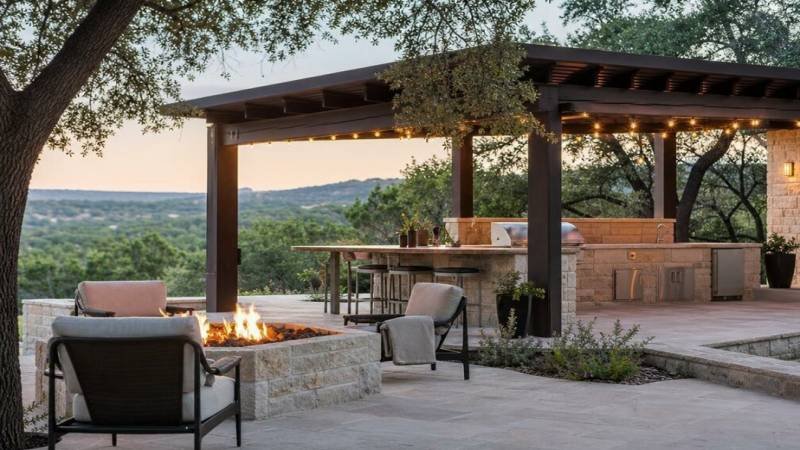
A backyard retreat earns its value when all three zones function as a single outdoor room. The arrangement of the outdoor kitchen, fire pit, and pergola relative to each other and to the home determines whether the space truly works.
Sequencing the Three Zones: Kitchen, Hearth, and Shade
Standard layout logic places the outdoor kitchen adjacent to the interior kitchen wall, reducing service distance. The pergola covers the dining zone beside it, creating a shaded all-weather area. The fire pit anchors a secondary gathering destination 15 to 20 feet away, separating the task zone from the social hearth. Traffic flow between zones should be paved continuously; the Hill Country rainy season renders grass paths muddy and unusable.
Hardscape, Drainage, and the Austin Soil Challenge
Blackland Prairie soils in the eastern suburbs are expansive black clay; Hill Country sites sit on shallow limestone that drains rapidly. For clay-bearing sites, correct specification means a compacted base layer, a minimum 1 to 2 percent drainage slope, and a French drain system where grade permits. Flagstone set in mortar over a concrete slab suits primary entertaining areas. Hardscape installed without these provisions will shift and crack within a few seasons.
Landscape Design as the Finishing Layer
Drought-tolerant natives are the correct choice given Austin’s watering restrictions. Texas live oak (Quercus fusiformis) and Monterrey oak provide canopy and privacy. Texas mountain laurel (Sophora secundiflora) offers ornamental structure and fragrance. Gulf muhly (Muhlenbergia capillaris) adds seasonal color along hardscape edges without irrigation demand.
Frequently Asked Questions
How Long Does It Take to Build a Custom Outdoor Kitchen in Austin?
A fully custom outdoor kitchen typically takes 10 to 20 weeks from design approval through final installation, depending on material lead times and site complexity. Projects involving custom masonry, specialty appliances, or permits for gas and electrical work tend to run toward the longer end. Seven Custom Homes coordinates all trades and permits under one project timeline.
Do Outdoor Kitchens Increase Home Resale Value in the Austin Market?
Well-built outdoor kitchens consistently add measurable resale value in Austin. Industry research indicates high-quality additions can return between 100 and 200 percent of their cost in warm-climate markets like Central Texas. Buyers in the luxury segment specifically expect these spaces, and their absence can reduce competitive interest in a listing.
What Permits Are Required for an Outdoor Kitchen Build in Austin?
Most projects require permits for gas line connections, electrical work, and any new structural elements such as a covered pergola or attached pavilion. The City of Austin requires inspection sign-offs before gas appliances can be activated. Seven Custom Homes handles all permit applications and inspections as part of the build process.
Can an Outdoor Kitchen Be Added to an Existing Home, or Only Built with New Construction?
Outdoor kitchens can be added to an existing home. The main considerations are access to existing gas, water, and electrical lines, and whether the current patio slab is engineered to support additional load. A site evaluation early in the design process identifies any structural or utility upgrades needed before construction begins.
How Do You Maintain a Custom Outdoor Kitchen Through Austin’s Weather Extremes?
Stainless steel appliances should be covered or wiped down with a protectant during extended disuse, and natural stone countertops need resealing once or twice per year. Gas lines and connections should be inspected annually by a licensed plumber, particularly after a hard freeze, to catch stress fractures before the spring entertaining season.
Is a Pool and an Outdoor Kitchen Too Much to Combine in One Backyard Project?
Combining a pool and outdoor kitchen in a single project is the most efficient approach, allowing both elements to be designed and permitted together. Pool excavation and plumbing should be completed before surrounding hardscape is poured. Seven Custom Homes designs these projects as integrated outdoor rooms so the kitchen, pool deck, and landscape read as one cohesive space.
What Is a realistic budget range for a Luxury Outdoor Kitchen in the Austin Area?
Entry-level custom outdoor kitchens with quality appliances and masonry construction typically start around $40,000 to $60,000. Full luxury builds including a covered structure, built-in refrigeration, multiple cooking stations, and integrated lighting and audio can reach $150,000 or more. Seven Custom Homes provides detailed pre-construction pricing with no allowance-based estimates that shift during the build.
About Seven Custom Homes
Seven Custom Homes is a luxury residential construction firm founded in 2007 by David Lyne, with offices at 312 Medical Parkway, Building B, Lakeway, TX 78738, serving Greater Austin and the Texas Hill Country. The company has completed more than $500 million in custom residential projects and has earned recognition including the 2014 Custom Builder of the Year award and the 2014 MAX Award. Their work spans architectural design, interior coordination, and outdoor living construction, planned as a unified process from initial site plan through project completion. See more.
Business Name: Seven Custom Homes
Address: 312 Medical Parkway, Building B, Austin, TX 78738
Phone Number: (512) 662-1349